
The floods, heatwaves and wildfires of recent years have delivered the same lesson to city halls on every continent: the climate a city was built for is not the climate it now lives in. In 2026, the response is visibly shifting from pledges to projects. From sponge streets that drink up stormwater to networks of cooling centres for the elderly, urban climate resilience has become one of the defining construction stories of the decade. This report, from the team at Honest News Daily, looks at what cities are actually building.
Heat: the silent emergency
Extreme heat now kills more people each year than any other weather hazard, and cities — with their asphalt, concrete and lack of shade — can run several degrees hotter than surrounding countryside. The response taking shape in 2026 is systematic rather than improvised. Cities are appointing chief heat officers, mapping their most vulnerable neighbourhoods, and building permanent cooling infrastructure: shaded bus stops, misting stations, reflective roofs and, above all, trees. Urban tree canopy programmes have expanded rapidly because a mature street tree can cool the air beneath it by several degrees while also slowing stormwater runoff.
The science underpinning these plans is summarised in the Intergovernmental Panel on Climate Change’s Sixth Assessment Report on impacts and adaptation, which warns that adaptation limits are already being reached in some regions — and that every fraction of a degree of warming avoided makes adaptation cheaper and more effective.
Sponge cities and the new war on flooding
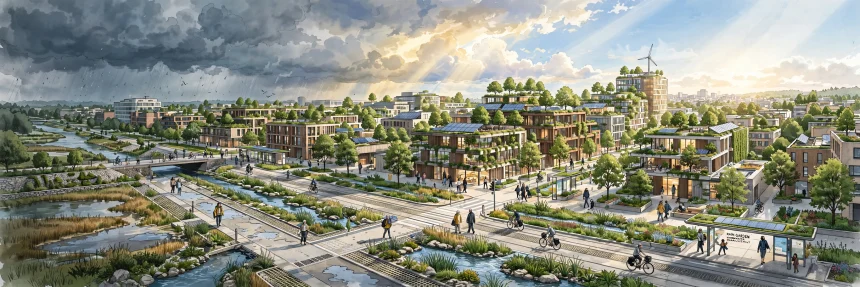
If heat is the slow emergency, water is the sudden one. Cloudbursts that overwhelm Victorian-era drains have pushed cities toward the “sponge city” model: permeable pavements, rain gardens, restored wetlands and sunken parks designed to absorb a storm and release it slowly. Rotterdam’s water squares double as basketball courts in dry weather and reservoirs in a deluge. Copenhagen, after a catastrophic 2011 cloudburst, has spent a decade building cloudburst boulevards that channel floodwater safely to the harbour. In 2026, versions of these ideas are being copied from New Orleans to Nairobi, adapted to local budgets and rainfall patterns.
Networks, not just concrete
Resilience is not only engineering. The C40 network of nearly 100 major cities, whose work you can explore at C40 Cities, has become a clearing house for what actually works: early-warning systems that reach residents by text message in their own language, buddy systems that check on elderly neighbours during heatwaves, and insurance schemes that pay out automatically when rainfall crosses a threshold, funding faster recovery. Officials increasingly argue that a well-tested warning system saves more lives per dollar than any wall.
The money question
None of this is cheap, and the financing gap remains the story’s unresolved chapter. Global adaptation finance still falls far short of estimated needs, and poorer cities — often those facing the worst impacts — struggle most to borrow. Yet the economics of inaction look worse: insurers are retreating from high-risk areas, and every major flood now carries a price tag in the billions. Insurers, pension funds and development banks have begun treating resilient infrastructure as an asset class in its own right, which is why so many of the projects announced in 2026 pair climate defences with housing, parks and transport upgrades that voters can see and use daily.
What comes next
The cities furthest ahead share a pattern: they stopped treating each disaster as a surprise. Long-term water plans, heat plans and building codes now assume the climate of 2050, not 1950. For residents, the changes will be tangible — greener streets, different building standards, new insurance realities. The age of assuming the weather will behave is over. The age of building for the weather that is actually coming has begun.