

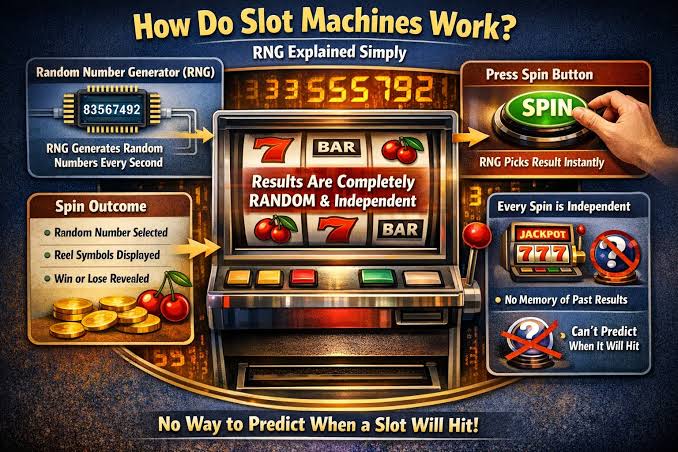
Every digital slot game operates through a combination of mathematical rules, software algorithms, and technical safeguards. While players see spinning reels, colorful symbols, and animated bonus features, a complex process determines which results appear on the screen.
The foundation of fair slot gacor game systems is randomization technology designed to produce outcomes according to established mathematical probabilities. This technology helps prevent predictable sequences and ensures that results follow the game’s approved configuration.
However, randomness and fairness are not identical concepts. A game may generate genuinely unpredictable outcomes while still maintaining a mathematical house edge. Understanding how slot games maintain random outcomes requires examining random number generators, software security, mathematical testing, and regulatory oversight.
Understanding Fairness in Modern Slot Game SystemsWhat Does Fairness Mean in Online Slots?
Fairness in regulated slot gaming generally means that outcomes follow documented rules and approved mathematical configurations without unauthorized interference. It does not mean that every player receives equal payouts or that losses are eventually compensated. A fair game can produce significantly different results for different individuals because randomness naturally creates variation. Technical integrity depends on whether the system operates as specified rather than whether particular outcomes are financially favorable.
Why Randomness Is Essential for Game Integrity
Randomization prevents ordinary players and operators from determining individual outcomes through predictable sequences. Properly implemented systems select results according to established probabilities rather than personal characteristics or previous financial performance. This protects the integrity of game mechanics, provided the implementation is secure and independently evaluated where required. Randomness also explains why repeated unfavorable outcomes do not necessarily indicate software manipulation.
Fairness Does Not Mean Guaranteed Profit
An important distinction exists between mathematically fair operation and profitable gambling. Most commercial slot games include a theoretical house edge, meaning their expected long-term payouts are lower than total wagers. A game can satisfy technical fairness standards while producing financial losses for individual players. Consequently, certification should never be interpreted as a guarantee of winnings, predictable jackpots, or positive account balances.
The Role of Random Number GeneratorsHow RNG Technology Produces Outcomes
A Random Number Generator, commonly called an RNG, produces numerical values used by gaming software to determine outcomes. The game maps these values to reel positions, symbol combinations, or other predefined results. Each outcome must follow the mathematical configuration established by the developer. The RNG supplies randomization, while the game’s rules determine how generated values translate into visible gameplay events.
Understanding Pseudorandom Number Generation
Most digital gaming systems use pseudorandom number generators, which rely on mathematical algorithms and internal states to produce sequences designed to behave unpredictably. Although their operation is computational, appropriate implementations can generate values suitable for regulated gaming requirements. Reliability depends on the algorithm, initialization process, security protections, and technical validation. A poorly implemented generator may introduce weaknesses that require correction.
Why Secure Seeding Matters
A pseudorandom generator begins from an internal state influenced by initialization information commonly called a seed. If unauthorized parties can predict or control relevant initialization values, the system’s unpredictability may be compromised. Secure implementations therefore require appropriate entropy sources, state protection, and controlled system access. The precise requirements depend on the technology and applicable regulatory standards.
What Happens Behind Every Slot Spin?Step 1: Processing the Spin Request
When a player activates the spin control, the system receives a request to perform a game event. Depending on its architecture, the authoritative outcome may be determined through a server-based gaming application or another approved implementation. The software verifies the applicable game state and processes the request according to its configured rules.
Step 2: Selecting the Mathematical Outcome
The game uses random values to select an outcome according to its probability model. These values may correspond to virtual reel stops, symbol arrangements, or other defined possibilities. Different combinations can have different probabilities because the game mathematics establish how the random values are interpreted. Randomness does not require every possible outcome to occur equally often.
Step 3: Displaying Symbols and Animations
After the outcome is selected, the interface displays the appropriate reel movements, symbols, and visual effects. In many implementations, animations communicate an already determined result rather than influencing it. Changing animation speed or pressing a visual stop control therefore does not necessarily affect the authoritative outcome. The exact behavior depends on the documented game design.
How Slot Mathematics Support Fair OutcomesSymbol Weighting and Probability Distribution
Digital slot games may assign different probabilities to particular symbols or reel positions. This mathematical weighting determines how frequently specific combinations can occur. Rare symbols may contribute to substantial potential payouts, while more common combinations may produce smaller rewards. A valid randomization system must follow these predefined probabilities rather than selecting every symbol with identical frequency.
Understanding Return to Player
Return to Player, or RTP, represents the theoretical proportion of wagers returned over a sufficiently large volume of play. For example, a game with 96% theoretical RTP has an expected long-term return of approximately 96 units for every 100 units wagered. This is a mathematical expectation, not a promise about individual sessions. Actual results may differ substantially.
How Volatility Influences Payout Patterns
Volatility describes variation in a game’s payout distribution. High-volatility games may concentrate substantial rewards in relatively rare events, while lower-volatility titles generally distribute smaller payouts more evenly. Both types can follow legitimate mathematical configurations. Volatility should therefore be understood as a characteristic of reward distribution rather than evidence that one game is inherently fairer than another.
Why Previous Spins Should Not Control Future ResultsUnderstanding Independent Outcomes
In slot games designed with independent spins, the probability distribution governing the next outcome does not change because of earlier results. A previous jackpot does not automatically reduce the possibility of another jackpot, and consecutive losses do not create an obligation for compensation. Certain games include documented persistent features or special states, but these operate according to explicit rules rather than hidden corrective mechanisms.
The Gambler’s Fallacy Explained
The gambler’s fallacy occurs when someone believes that a particular random outcome becomes more likely because it has not appeared recently. For example, several unsuccessful spins may create the impression that a substantial payout is approaching. However, independent random outcomes do not follow a schedule designed to balance short-term results. Misunderstanding this principle can encourage unnecessary financial risks.
Why Winning Schedules Are Unreliable
Promotional claims about guaranteed winning hours or predictable payout cycles generally lack credible mathematical support. Properly implemented independent randomization systems do not produce rewards simply because players access them at particular times. Historical results may display apparent patterns, but those patterns cannot reliably establish future outcomes. Understanding this limitation helps distinguish statistical information from unsupported predictions.
Independent Testing and Technical CertificationHow Gaming Laboratories Test RNG Systems
Qualified testing laboratories may evaluate randomization systems through statistical examinations, implementation reviews, and technical compliance assessments. These processes can investigate whether generated values satisfy relevant standards and whether outcomes follow approved mathematical rules. Statistical testing alone cannot establish every aspect of software security, making implementation analysis and appropriate technical documentation important components.
Verifying Payout Mathematics
Independent assessments may examine reel configurations, symbol probabilities, bonus features, and payout calculations. Auditors can compare the implemented game with its documented mathematical model to identify inconsistencies. Depending on regulatory requirements, testing may also involve simulations and software reviews. The objective is to verify compliance with specified criteria rather than guarantee financial success for individual users.
Recognized Testing Organizations
Organizations such as Gaming Laboratories International, eCOGRA, and BMM Testlabs provide testing or certification services within the gaming industry. Their assessments apply to particular products, systems, or regulatory requirements. A website displaying a laboratory logo is not automatically verified. Authentic certification requires confirmation of the relevant assessment scope and supporting documentation.
Software Security and Protection Against ManipulationPreventing Unauthorized Changes to Game Code
Gaming software must be protected against unauthorized modification because changes to mathematical rules or outcome selection could compromise integrity. Developers may implement access restrictions, integrity checks, deployment controls, and monitored update procedures. In regulated environments, significant modifications can require additional review or approval. Technical safeguards help ensure that the operating software remains consistent with its authorized version.
Protecting Communication Between Servers and Devices
Online slot platforms exchange information between gaming applications, servers, and user devices. Secure communication helps protect account data and game-related messages against certain interception or modification attacks. Encryption technologies such as TLS support this protection. However, encrypted connections cannot independently establish whether a gambling operator is licensed or trustworthy.
Monitoring Technical Errors and Suspicious Activity
Reliable gaming infrastructure requires appropriate monitoring of system errors, unauthorized access attempts, and unexpected application behavior. Technical logs can assist investigations and support operational accountability. Monitoring should be implemented with suitable privacy safeguards and regulatory controls. Detecting unusual activity helps identify potential problems, although monitoring cannot eliminate every security vulnerability.
How Fairness Applies to Modern Bonus FeaturesFree Spins and Multiplier Calculations
Free-spin rounds and multipliers operate according to predefined mathematical rules. Their activation conditions and payout calculations are incorporated into the game’s overall design. Some bonus features introduce additional random events, while others modify existing payout structures. Large multiplier values do not automatically establish favorable probabilities or guarantee that a bonus will recover its associated cost.
Cascading Reels and Symbol Replacement
Cascading games remove qualifying symbols and introduce replacements according to their specific rules. These sequences may produce additional combinations without requiring another ordinary spin. The mathematical model determines how replacements are selected and evaluated. Multiple cascades can occur within a single event, but their presence does not guarantee a profitable result.
Progressive Jackpots and Specialized Systems
Progressive jackpots may involve separate calculations, contribution mechanisms, and triggering conditions. Their operation differs between games and jackpot networks. Independent testing may examine these systems against applicable requirements. Players should consult official rules because jackpot probabilities and reward structures cannot be inferred reliably from promotional graphics or previous jackpot results.
The Importance of Regulatory OversightLicensing Requirements for Gaming Operators
Gambling regulators establish conditions under which authorized operators may provide services. These requirements can address software testing, financial controls, player protection, and security procedures. Licensing differs between jurisdictions, and authorization in one country does not automatically permit gambling activities elsewhere. Technical fairness should therefore be evaluated alongside the operator’s applicable legal status.
Ongoing Compliance and Software Updates
Game integrity requires attention beyond initial software certification. Updates, infrastructure changes, and newly introduced features may affect technical compliance. Depending on the jurisdiction, significant modifications can require additional testing or regulatory approval. Appropriate change management helps maintain consistency between approved game mathematics and deployed software.
Common Misunderstandings About Fair Slot SystemsCan Operators Choose Individual Winning Results?
A properly regulated system should operate according to its approved rules without unauthorized manipulation of individual outcomes. However, the existence of randomization technology alone cannot prove that every operator follows appropriate standards. Independent testing, secure implementation, and regulatory oversight provide stronger evidence of technical integrity.
Does Every Player Have the Same Winning Experience?
No. Players can experience substantially different results even when using the same game configuration. Random variation naturally produces unequal short-term outcomes. What matters for independently modeled play is whether the same applicable rules and probabilities govern the relevant game states, not whether everyone receives identical payouts.
Can Fair Games Still Produce Long Losing Streaks?
Yes. Extended sequences of unfavorable outcomes are mathematically possible in random games. Fairness does not require payouts to occur at fixed intervals or compensate for earlier losses. Such sequences should be interpreted through probability rather than assumptions about guaranteed future rewards.
Frequently Asked Questions About Slot RNG FairnessWhat Makes an Online Slot Game Fair?
A fair game follows its documented mathematical rules through properly implemented randomization and appropriate technical safeguards. Independent testing and regulatory oversight can provide additional evidence of compliance.
Can Random Number Generators Be Predicted?
Properly secured gaming RNG systems are designed to resist practical prediction. However, weak algorithms or implementation errors can create vulnerabilities, which is why technical testing matters.
Does RNG Guarantee That Everyone Will Win?
No. RNG technology supports random outcome selection. It cannot guarantee winnings, equal financial returns, or profitable sessions.
Are Certified Slot Games Completely Risk-Free?
No. Certification addresses specified technical requirements. It does not eliminate the house edge, financial losses, software risks, or every potential operational problem.
Can Previous Jackpot Results Influence Future Spins?
In games with independent outcomes, previous jackpots do not determine subsequent results. Any documented persistent mechanics must be evaluated according to their specific rules.
Does Higher RTP Mean a Game Is Fairer?
Not necessarily. RTP describes theoretical payout expectations, while fairness concerns whether a game operates according to its approved rules. Both characteristics are important but measure different things.
Why Is Independent Testing Important?
Independent testing provides evidence that selected gaming systems meet specified technical requirements. It supports accountability by reducing reliance on unsupported claims from software developers or operators.