

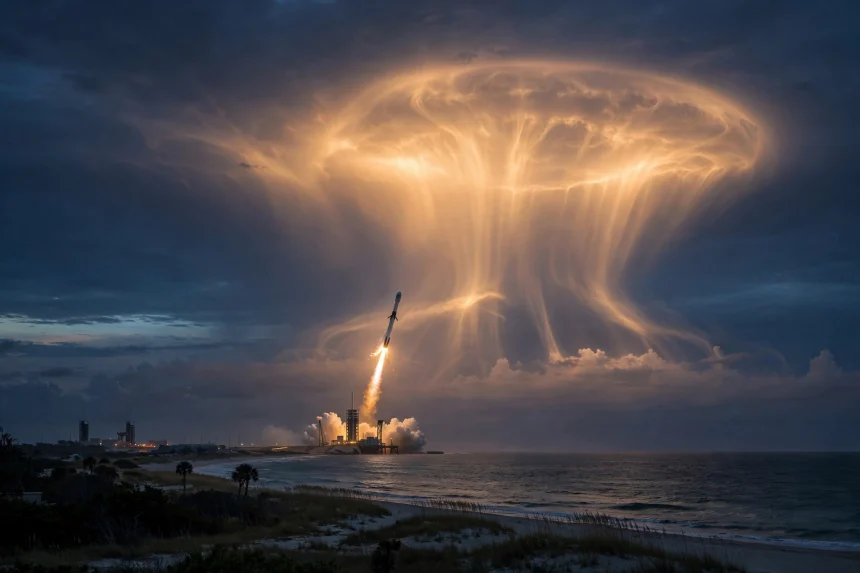
Early risers along the United States East Coast were treated to an unusual sight before sunrise on Tuesday, October 13, when a SpaceX Falcon 9 rocket climbed away from Florida and its exhaust plume blossomed into a vast, glowing shape that many witnesses compared to a jellyfish drifting across the dawn sky. Photos shared from beaches, highways and back gardens showed a bright, translucent cloud with long, curling tendrils, visible across a wide stretch of the eastern seaboard while the ground below was still in darkness.
The launch, which lifted off at 6:33 a.m. Eastern Time from Space Launch Complex 40 at Cape Canaveral Space Force Station, was SpaceX’s 35th commercial resupply mission for NASA. Its uncrewed Dragon spacecraft is carrying scientific investigations, supplies and equipment to the International Space Station, and is scheduled to dock with the orbiting laboratory on October 15. NASA’s own account of the launch describes how the illuminated plume became visible across the eastern United States.
Why the Plume Looked Like a Jellyfish
The phenomenon, often called a “space jellyfish,” is a trick of timing, altitude and sunlight rather than anything mysterious. A rocket launched shortly before sunrise or just after sunset climbs quickly into a part of the sky that is already lit by the sun, even though observers on the ground are still standing in twilight or darkness. As the vehicle reaches the thin upper atmosphere, its exhaust gases and water vapour expand rapidly because there is far less air pressure to contain them.
That expanding plume spreads into a broad, rounded cloud, and the water vapour within it can freeze into tiny ice crystals. When sunlight strikes those crystals at high altitude, the whole formation glows against the darker sky below, while thinner streams of exhaust trail beneath it like tentacles. Stage separation and changes in engine activity can add extra curls and rings, which is why no two displays look exactly alike and why forecasters who track launch windows can sometimes predict a good show in advance.
A Cargo Mission Behind the Spectacle
Beyond the visuals, the flight was a routine but important logistics run. Cargo Dragon missions keep the space station stocked with food, hardware and experiments, and this flight carried thousands of pounds of payload, including research equipment that will be installed and run by the station’s crew in the coming weeks. The Falcon 9 first stage, flying for the eighth time, was planned to return to a landing zone at Cape Canaveral, adding the short, sharp sonic booms that Space Coast residents often report after dawn launches.
Reusable boosters and a steady cadence of resupply flights have made scenes like Tuesday’s increasingly common. Readers who follow how coastal communities adapt to changing conditions may also enjoy our recent look at how cities are preparing for extreme weather, another story in which the sky plays a central role.
How to Catch the Next One
Skywatchers hoping to see a future display should watch for launches scheduled in the hour before sunrise or after sunset, when the geometry that creates the effect is most favourable. Clear skies matter, and the best views usually come from open locations with an unobstructed horizon in the direction of the launch site. Because a rocket heading northeast along the Atlantic coast passes over a long chain of states, people hundreds of miles from Florida can still see the plume once it reaches high altitude.
A few practical tips help: check the launch schedule the night before, allow for delays, and give your eyes several minutes to adjust to the dark. Photographers generally get the best results with a tripod and slightly longer exposures, which capture the plume’s soft structure. And if the early start feels like a sacrifice, our guide to planning a balanced entertainment break is a reminder that the best spectacles are the ones you schedule time to enjoy.
A Reminder of How Routine Spaceflight Has Become
Perhaps the most striking part of Tuesday’s display is that the mission behind it was entirely routine. A glowing jellyfish in the dawn sky is what happens when cargo logistics, atmospheric physics and sunrise happen to align. As commercial resupply flights continue through the rest of the year, East Coast residents may not have to wait long for the next one — they will just need a clear morning, an early alarm and a view to the southeast.