
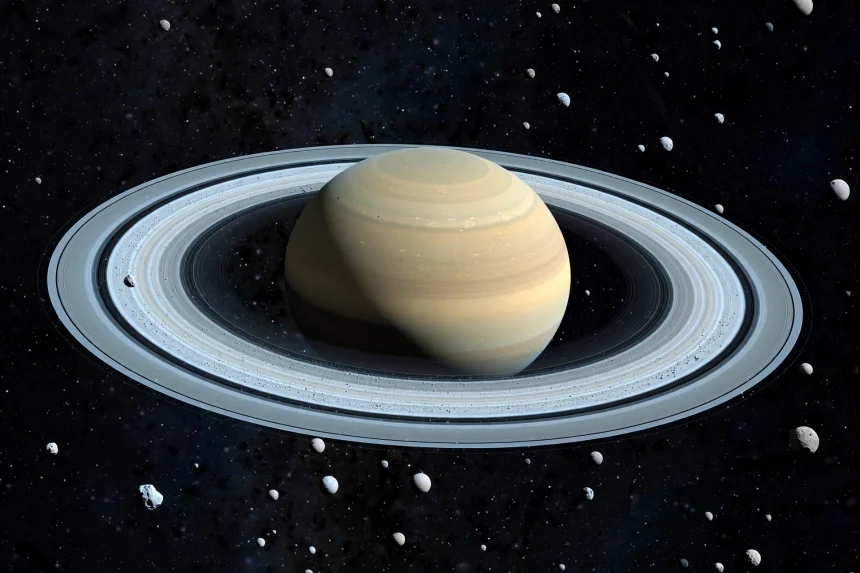
Saturn now officially has 274 moons. Astronomers have confirmed 128 new satellites of the ringed planet, a single announcement that adds more moons than most planets will ever have and cements Saturn’s status as the solar system’s runaway leader in natural satellites.
To put the figure in context, Jupiter — long Saturn’s only serious rival in this particular contest — has 95 recognised moons. Earth has one. The new Saturnian moons are admittedly modest: irregular lumps of rock and ice, typically a few kilometres across, orbiting far from the planet in tilted, looping paths.
Years of watching one patch of sky
The moons emerged from observations with the Canada-France-Hawaii Telescope, where researchers photographed the region around Saturn again and again and combined the images to reveal objects too faint for any single exposure. Candidates then had to be followed until their orbits were secure, a process measured in years rather than weeks.
Only then did the International Astronomical Union add them to the official list. The analysis was led by astronomers at the University of British Columbia, who have now been responsible for a large share of Saturn’s recent moon discoveries.
It is a different kind of space story from the Falcon 9 launch that painted a jellyfish across the dawn sky: no countdown, no launch — just persistence, software and very dark skies.
Debris with a story to tell
Scientists believe irregular moons are mostly captured objects and collision fragments. Groups of them share tell-tale orbital similarities, marking them as pieces of a larger body that broke up after being seized by Saturn’s gravity. Every newly confirmed member refines the family tree and helps researchers estimate when those break-ups happened.
That makes the moons evidence in a much bigger investigation: how the giant planets formed, how they moved in the young solar system, and how much material was flying around for them to capture. A census that jumps by 128 at a stroke materially improves the statistics behind those theories.
Honest caveats about a headline number
The record comes with an asterisk that astronomers themselves are quick to supply. The moon counts of Saturn and Jupiter reflect telescope sensitivity as much as nature; both planets likely have thousands of small satellites that no survey has yet detected. A future instrument could reshuffle the standings, although Saturn’s current lead of 179 moons would take some catching.
For now, though, the number stands: 274 confirmed moons, each one tracked, catalogued and recognised. In an era of fast headlines, there is something satisfying about a record built one faint dot of light at a time.
How a moon earns its place on the list
It is worth pausing on what “confirmed” means, because the word does much of the work in this story. A moon is not confirmed when it is first photographed. It is confirmed when astronomers have observed it often enough, across enough of its orbit, to predict its position years into the future. Until then it remains a candidate, tracked under a provisional designation and at constant risk of being lost.
That discipline explains the size of this announcement. The survey team did not find 128 moons in a single season; they accumulated candidates over years, then invested further years in follow-up observations, often recovering objects at the very edge of detectability exactly where their calculations said the moons should be. Each recovery strengthened an orbit; each completed orbit went forward for recognition.
The same rigour guards against embarrassment. More than one celebrated “new moon” in the history of astronomy has turned out to be a background asteroid, a camera artefact or a known object misidentified. The 128 moons in this announcement have survived a process designed to eliminate exactly those errors, which is why the figure of 274 can be stated plainly — and why it will stand until the next, deeper survey is ready to challenge it.