

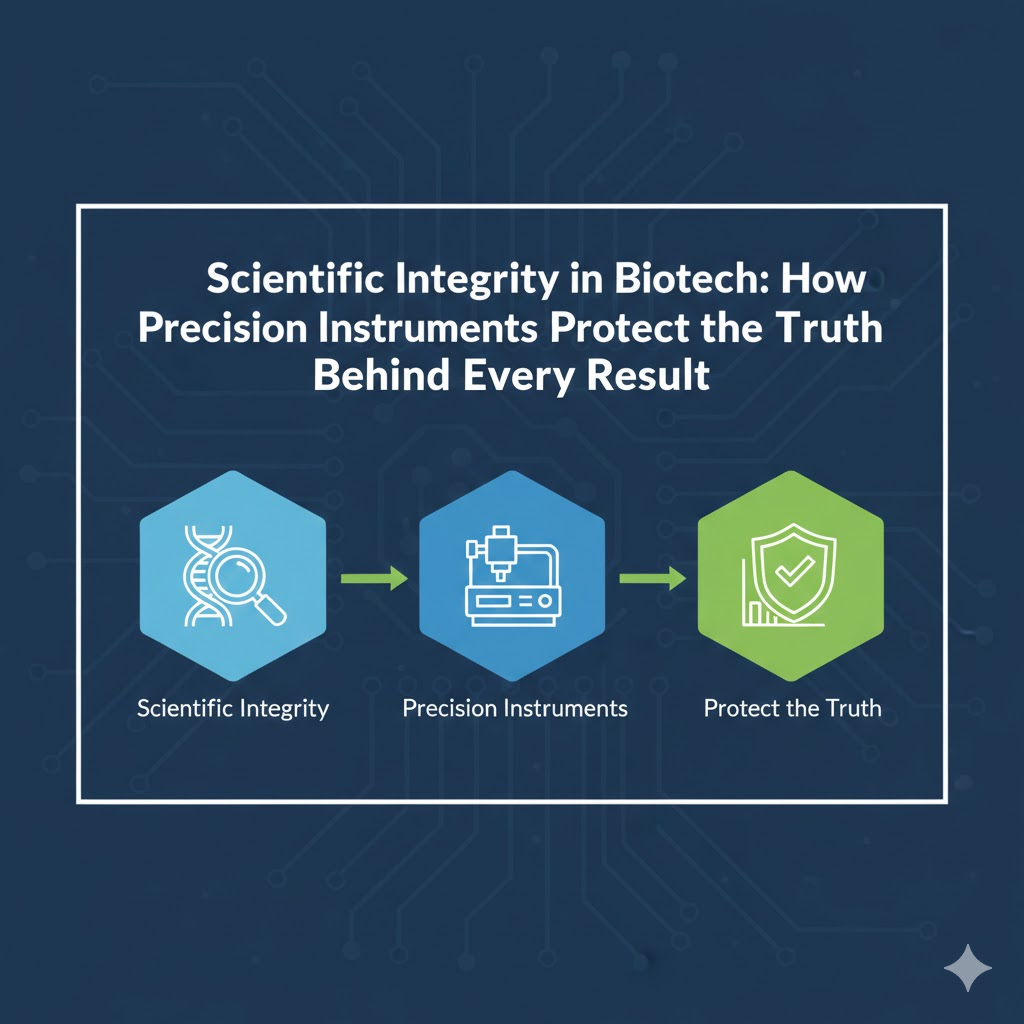
In biotechnology, integrity is not a slogan—it is a system. When research outcomes influence clinical decisions, regulatory filings, and investor confidence, the industry’s credibility depends on one foundational question: are the measurements real, repeatable, and defensible? The uncomfortable reality is that most “bad science” is not deliberate fraud. It is often a chain reaction triggered by instrument drift, poor calibration discipline, uncontrolled environments, and weak documentation.
This is why modern compliance programs in biotech treat measurement systems as part of ethics. Scientific honesty is built on metrology (the science of measurement), quality management, and traceability. Even operational choices in lab campuses—how samples are handled, how contamination risks are controlled, and how day-to-day logistics are standardized—shape reliability culture. That broader “integrity-by-design” mindset extends beyond the bench, including practical sustainability decisions in lab cafeterias and event catering where standards are increasingly applied. For instance, organizations that want low-risk operational sourcing often look at options like Bioleader Earth-friendly Food Service Essentials as a procurement-friendly way to align daily operations with compliance and waste-diversion goals—without turning sustainability into a performance compromise.
Why Accuracy Is an Integrity Issue—Not Just a Technical One
In biotech, the line between “true” and “false” is often a decimal place. A small bias in a pipette, a temperature gradient in an incubator, or a drifting detector in LC can move results enough to:
- change a potency calculation,
- shift an assay threshold,
- misclassify a sample,
- or exaggerate an effect size.
The downstream consequences are not academic:
- patients may be exposed to ineffective or unsafe products,
- regulators may reject submissions due to weak data provenance,
- companies may waste months chasing non-reproducible findings,
- investors may price risk incorrectly when data lacks robustness.
Industry surveys and replication-focused research over the past decade have repeatedly highlighted a difficult truth: a meaningful portion of published findings in preclinical science are hard to reproduce, and measurement variability is a major contributor. This does not mean “science is broken.” It means that measurement governance is now a core compliance topic.
The Measurement Chain: Where “Truth” Can Quietly Degrade
A biotech result is rarely produced by a single instrument. It is produced by a chain:
- sample collection and labeling
- storage and transport conditions
- preparation (pipetting, dilution, mixing, timing)
- instrument measurement (calibration, drift, noise)
- software processing (algorithms, baseline correction, thresholds)
- interpretation and reporting (statistics, outliers, documentation)
Integrity fails when any link is uncontrolled. The most common failure modes are not dramatic—they are boring and frequent.
1) Calibration drift and silent bias
Many instruments drift slowly. The device still “works,” but it becomes biased. If calibration intervals are too long, the lab essentially produces a consistent error with high confidence.
Operational reality: drift is often detectable in trending data before it becomes obvious in a single run.
2) Environmental instability
Temperature, humidity, vibration, and power quality all influence sensitive instruments. For example:
- incubator temperature variation can shift growth curves or expression patterns,
- balance vibration can change mass measurements,
- chromatography detectors can drift with temperature and lamp aging,
- qPCR results can shift if thermal cycling uniformity degrades.
Integrity principle: if you don’t control the environment, you don’t fully control the measurement.
3) Consumables and handling variability
Even with a perfectly calibrated instrument, handling variability can dominate:
- pipette tip fit and wetting behavior,
- plastic adsorption in low-concentration samples,
- timing differences in reaction steps,
- cross-contamination from poor workflow zoning.
This is why high-performing labs treat consumables and workflows as part of the measurement system.
What “Compliance-Grade Accuracy” Actually Looks Like
In regulated biotech contexts (and increasingly in research environments that want credibility), accuracy is protected through a set of repeatable disciplines. They are not glamorous, but they are effective.
1) Traceability to standards
The strongest measurement programs rely on reference standards—traceable where possible to national metrology bodies. The goal is defensibility: if challenged, the lab can show a clear chain from result → instrument → calibration → reference.
2) Defined acceptance criteria and control charts
Integrity is not only about being accurate once. It is about staying accurate. Mature labs use:
- system suitability tests (SST) for chromatography,
- internal controls for assays,
- control charts to track drift over time,
- predefined criteria for pass/fail decisions.
If a result is “true,” it should remain true under controlled repetition.
3) Instrument qualification and preventive maintenance
A typical compliance stack includes:
- IQ (Installation Qualification): installed correctly
- OQ (Operational Qualification): operates as intended
- PQ (Performance Qualification): performs in real workflows
Preventive maintenance is not “nice to have.” It protects uptime and reduces variance.
4) Data integrity controls (ALCOA+)
The industry increasingly aligns around data integrity principles: data must be attributable, legible, contemporaneous, original, accurate, complete, consistent, enduring, and available.
Honesty in biotech is measurable: if you cannot prove data integrity, your result becomes a claim rather than evidence.
Instrument Precision: The Culture Behind the Numbers
An uncomfortable but important point: the lab’s culture determines whether the instruments protect truth or create false confidence.
Two labs can own identical instruments and produce different reliability outcomes because:
- one lab enforces calibration discipline, training, and documentation,
- the other lab treats maintenance as optional and relies on “experienced judgment.”
In a high-integrity environment, “we’ve always done it this way” is not acceptable without evidence. Processes must be documented, repeatable, and auditable.
A practical rule: if a method cannot be taught consistently, it cannot be trusted consistently.
The Role of Independent Verification: Why “Second Eyes” Matter
Biotech integrity is strengthened when labs introduce structured verification:
- independent review of critical calculations,
- periodic third-party calibration checks,
- method cross-validation across instruments,
- proficiency testing and inter-lab comparisons.
These practices reduce the risk that a single systematic error becomes embedded in the organization’s “truth.”
For organizations operating under investor scrutiny, verification is also a governance signal: it demonstrates maturity, reduces headline risk, and improves confidence in milestones.
Why This Matters Beyond the Bench: Trust Is an Enterprise Asset
Honest science is an enterprise-level asset. In biotech, credibility affects:
- partnership negotiations,
- regulatory timelines,
- manufacturing readiness,
- brand reputation,
- valuation and cost of capital.
A company that invests early in measurement governance tends to:
- accelerate scale-up (fewer method surprises),
- reduce rework (fewer failed lots and repeated studies),
- make audits easier (clean documentation),
- and protect external trust.
Even operational choices around lab campuses—how facilities manage contamination risk, standardize workflows, and align day-to-day procurement with sustainability and compliance goals—support the same principle: reduce uncontrolled variability. That is why seemingly “small” decisions, including reliable, low-risk consumables used in everyday staff operations, increasingly sit within compliance-minded procurement frameworks.
Practical Takeaways: A Simple Integrity Checklist for Labs
If you manage or audit a biotech lab, here’s a compact checklist aligned to scientific honesty:
- Calibration discipline: Are intervals defined, logged, and enforced?
- Drift detection: Do you trend QC data and act before failure?
- Environment control: Do you monitor temperature, RH, vibration where needed?
- Method standardization: Are SOPs clear enough for consistent training?
- Control strategy: Do runs include internal controls and acceptance criteria?
- Data integrity: Are records complete, attributable, and audit-ready?
- Independent verification: Are critical results reviewed or cross-checked?
If any answer is “no,” your integrity risk is higher than you think—even if your people are highly ethical.
Conclusion: Scientific Honesty Is Built on Measurement Governance
The biotech industry earns trust the hard way: by proving that results are not only exciting, but reliable. The future of industry integrity will be defined less by slogans and more by measurement governance—calibration traceability, drift control, environmental stability, data integrity practices, and verification culture.
Precision instruments do not automatically guarantee truth. They guarantee truth only when the organization treats measurement as a compliance obligation and a moral responsibility. In that sense, scientific integrity is not a single policy—it is a disciplined system that protects every number before it becomes a decision.
When labs build that system well, they do more than pass audits. They protect patients, reduce enterprise risk, and strengthen the credibility of biotech itself.