

Key Takeaways
- Watch the 60,000 to 100,000 mile stretch closely that’s when domestic vehicles rack up the most expensive failures, and it’s exactly when factory coverage runs dry.
- Check your emergency fund before you skip an extended car warranty. If you can’t cover a $3,000 to $5,000 transmission or AC compressor repair in cash, a service contract turns that risk into a manageable monthly payment.
- Treat a used car purchase with no maintenance records as a red flag, not a bargain. An extended warranty fills the gap left by an unknown repair history.
- Don’t assume low mileage means low risk. High-mileage commuters (15,000+ miles a year) wear out alternators, suspension parts, and transmissions faster than the odometer suggests.
- Compare powertrain, essential, and premium coverage tiers before buying — the right plan depends on your vehicle’s age, mileage, and which systems are already showing wear.
- Pick a provider that lets you use any ASE-certified shop, not just a dealership. Flexible repair access matters as much as the coverage list itself.
82,000 miles. That’s roughly where a lot of domestic sedans and trucks start racking up repair bills that make owners wince. The factory bumper-to-bumper coverage is long gone by then, and the powertrain warranty is either expiring or already expired. So what happens when the transmission starts slipping three months after that coverage lapses? For most families, it means a credit card bill nobody budgeted for.
Here’s the honest math: an extended car warranty isn’t about babying a car that’s going to run fine forever. It’s about recognizing that certain mileage thresholds carry real, measurable failure probability deciding whether you can absorb that risk out of pocket or whether you’d rather pay a predictable monthly amount instead. Domestic vehicles between 60,000 and 100,000 miles sit right in that window where alternators, AC compressors, and transmission components start failing at meaningfully higher rates than earlier in the vehicle’s life.
Most owners don’t think about coverage until something breaks. That’s backwards. The smarter move is spotting the warning signs before the repair bill lands a flickering check engine light, a used car with no service history, a factory warranty that expires next month. Some of these signs are obvious. Others hide in plain sight, buried in mileage logs or maintenance receipts you haven’t looked at in years.
Below are seven signs worth taking seriously, along with the budget math behind each one.
Why the 60,000 to 100,000 Mile Window Is the Riskiest Stretch for Domestic Vehicles
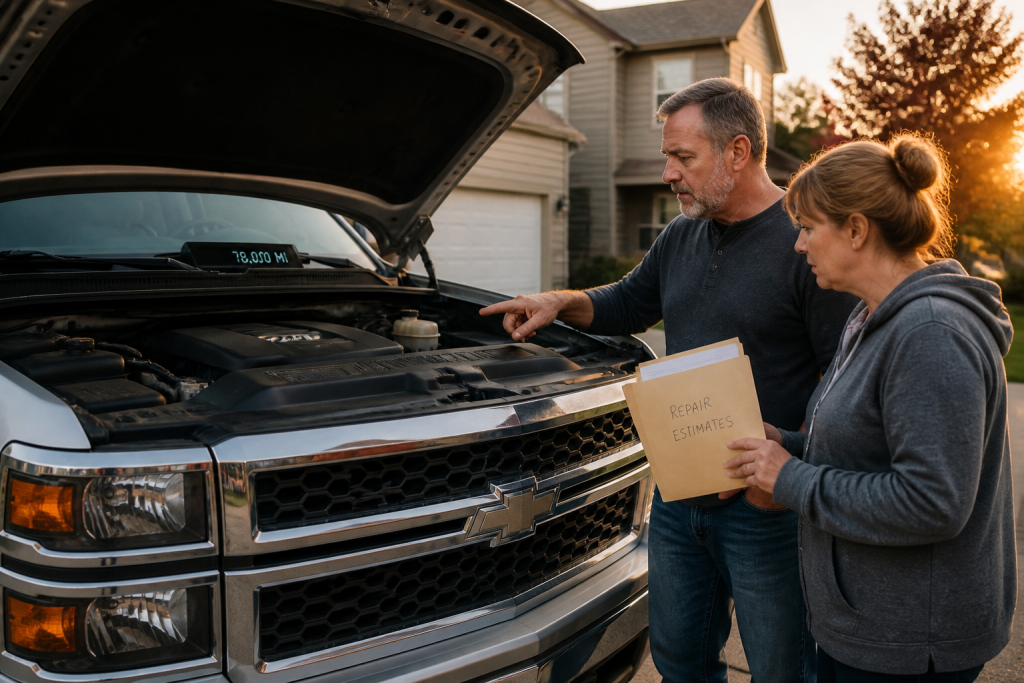
Picture a Chevrolet Silverado sitting at 78,000 miles. The transmission starts slipping on hills — right after the factory coverage lapsed. That’s not bad luck. It’s math. Domestic trucks and sedans hit peak wear on transmissions, AC compressors, and electrical modules right in this mileage band, and repair bills of $2,500 to $5,000 show up with no warning.
The Failure-Probability Curve Every Owner Should Understand
Failure rates aren’t flat across a car’s life. They stay low early, then climb sharply between 60,000 and 100,000 miles as seals harden, sensors degrade, and factory-grade fluids break down. Shopping for an extended car warranty before this climb begins is simply timing the risk curve correctly.
What Happens Financially When the Factory Warranty Runs Out
Once that factory clock hits zero, every repair bill lands on you full stop. No buffer, no shared cost. Families without $4,000 sitting in reserve end up financing repairs on credit cards at double-digit interest, turning one bad alternator into months of debt.
Sign One: Your Factory Powertrain Coverage Is About to Expire
The math is simple: once that factory clock runs out, you’re the insurance company. Most manufacturers cap powertrain protection around 60,000 to 100,000 miles and the odometer doesn’t wait for you to save up. Ford, Toyota, and Hyundai all structure coverage this way, and once it lapses, engine or transmission failures land squarely on your credit card.
Here’s what most people miss: the 30-60 day window before expiration is the cheapest and easiest time to lock in an extended car warranty. Wait until after that window closes, and some plans start requiring inspections or add waiting periods before coverage kicks in.
A few practical checks:
- Check your original sales paperwork or owner’s manual for the exact mileage cutoff.
- Call the dealership service department they’ll tell you your remaining months, not just miles.
- Don’t assume a used car’s warranty is transferable; confirm it in writing.
Realistically, once the factory safety net disappears, you’re one bad sensor away from a four-figure bill. That’s the moment to start shopping coverage, not after the check engine light comes on.
Sign Two: You’ve Noticed the Check Engine Light More Than Once This Year
How many times has that little orange light popped on this year? Twice? Three times? If you’ve lost count, your car is telling you something a quick reset won’t fix.
Electrical and Sensor Costs on Domestic Cars
Domestic cars Ford, Chevrolet, and their siblings rely on dozens of sensors and control modules to keep the engine running clean. A failing oxygen sensor, a bad throttle body, or a glitchy ignition control module can each trigger that same light, and diagnosis alone can run $150-$200 before any part gets replaced.
Here’s what most people miss: repeat check engine lights often point to a module problem, not a sensor. Replacing an engine control module can cost $800-$1,500 with labor. That’s real money for a family working with a tight repair budget.
An extended car warranty with electrical component coverage absorbs those diagnostic and repair bills instead of your checking account. If the light keeps coming back, treat it as a financial warning, not just a mechanical one.
Sign Three: Your Transmission Has Over 60,000 Miles and No Service Records
Roughly 40% of transmission failures trace back to fluid that was never changed on schedule. That’s not a small number it’s the single biggest predictor mechanics look for when a car rolls into the shop with a slipping gear or a hard shift.
Transmissions don’t fail out of nowhere. They fail because heat breaks down fluid, friction builds, and internal components wear faster than they should. If you bought your car used and there’s no paperwork showing fluid changes around 60,000 miles, you’re driving blind. No records doesn’t mean the work was done and just wasn’t logged. More often, it means it wasn’t done at all.
Here’s what most people miss: a transmission rebuild runs $2,800 to $5,000 depending on the make. Replacement often costs more. An extended car warranty covering powertrain components picks up that repair bill instead of forcing you to finance it. Given the gap in service history, this is where coverage earns its keep fastest.
Sign Four: You Don’t Have $3,000 to $5,000 Sitting in an Emergency Fund
Here’s a myth worth killing: an extended car warranty isn’t for people who can’t manage money. It’s for people who understand math. Most families keep $1,000-$2,000 in reserve — not $5,000 earmarked for a transmission.
Running the Budget Math on Self-Insuring a Repair
Self-insuring means betting your savings against the odds.
A transmission rebuild runs $2,800-$4,500 on a domestic sedan or truck. An AC compressor with related parts can hit $1,200. If your fund covers rent, groceries a car repair something breaks. Literally.
What a Monthly Coverage Payment Actually Replaces
A coverage plan swaps one unpredictable $4,000 hit for a predictable payment you can budget around. That’s not spending it’s converting chaos into a line item. For families without a dedicated repair cushion, this is the practical difference between an inconvenience and a financial setback that takes months to recover from.
Sign Five: You Bought the Car Used With an Unknown Maintenance History
A family buys a five-year-old sedan with 68,000 miles from a used-car lot. The listing says “well maintained.” There’s no service history, no receipts, nothing. Six months later the transmission starts slipping — and now they’re stuck guessing whether the previous owner ever changed the fluid.
That’s the real risk with used vehicles: you’re inheriting someone else’s decisions. Did they skip oil changes for a year? Ignore a warning light? You have no way to know, and neither does the dealership.
Here’s what most people miss: factory coverage is usually gone or close to it by the time a car changes hands, so any hidden wear becomes your problem the day you sign the paperwork.
An extended car warranty purchased at the time of acquisition closes that gap immediately. Waiting until something breaks often triggers pre-existing condition exclusions — insurers aren’t going to cover a problem that started before the contract existed. If you can’t verify service records, treat the purchase itself as the trigger point for coverage, not an afterthought.
Sign Six: You Drive More Than 15,000 Miles a Year for Work or Family Logistics
Mileage kills parts faster than a calendar ever will.
A car sitting in a garage for years barely wears down. A car logging 60 miles a day to work, then shuttling kids to practice, then running errands on weekends? That’s a different animal entirely.
Why Mileage Matters More Than Vehicle Age
Here’s the math: a 3-year-old car with 60,000 miles has seen the same wear as a 6-year-old car driven normally. Belts, seals, water pumps, and transmission components fail based on rotations and heat cycles — not birthdays. Domestic sedans and trucks used for commuting or ride-share work often hit the 100,000-mile danger zone years ahead of schedule.
If you’re piling on miles, an extended car warranty becomes less optional more of a scheduling decision. Waiting until 90,000 miles to shop coverage plans limits your options and can bump you into pricier tiers. Lock in protection while your mileage still qualifies for broader plans not after the transmission starts slipping on the highway.
Sign Seven: Your AC Compressor, Alternator, or Suspension Already Shows Wear
Ever notice your AC blowing warm on hot afternoons, or the dash lights flickering when you start the car? Those small annoyances aren’t random. They’re early warnings that three of the most expensive component groups on your vehicle are wearing out at the same time.
An AC compressor replacement typically runs $800 to $1,500.
An alternator failure often paired with a dying battery can run $500 to $900. Front suspension work (struts, control arms, bushings) adds another $600 to $1,200 per axle. Individually, each repair stings. Together, before 100,000 miles, they can wipe out a family’s repair budget in a single season.
Here’s the honest math: these systems don’t fail in isolation. Heat, vibration, and age wear them down together. If you’re hearing clunks over bumps, feeling a wandering steering wheel, or noticing your AC cycling on and off oddly, don’t wait for all three to fail before shopping for an extended car warranty. Essential or Premium coverage tiers specifically include AC, electrical, and suspension components exactly the systems showing wear right now.
What an Extended Car Warranty Actually Covers on a Domestic Vehicle
Here’s a number that stops most families cold: transmission failures average $3,500 to $8,000 to fix, and engine repairs run $2,000 to $6,000. That’s the math behind why an extended car warranty exists in the first place it’s not about maybe needing repairs, it’s about when.
Powertrain vs. Essential vs. Premium Coverage Explained
Powertrain coverage handles the big stuff engine internals, transmission, drive axles plus roadside help and towing. Essential coverage adds brakes, cooling systems, AC, fuel systems, and electrical components like the alternator and starter. Premium coverage goes further, adding suspension, ABS modules, and hybrid battery components for higher-mileage domestic cars pushing past 100,000 miles.
Common Exclusions Families Should Know Before Signing
Every plan excludes maintenance items oil, filters, brake pads, wipers, fluids. Wear items like tires and batteries aren’t covered either. Neither is pre-existing damage or neglect. Read the exclusions list before you sign. It’s shorter than you’d think, and knowing it upfront avoids a nasty surprise at claim time.
How Much Coverage Should Cost Relative to Your Repair Risk
Here’s a myth worth busting: the cheapest plan is rarely the best deal. Buyers assume a low monthly payment means savings, but a stripped-down powertrain plan on a vehicle that’s really at risk for AC, electrical, or suspension failures leaves the biggest repair bills uncovered. The math that matters isn’t the sticker price of a plan — it’s the gap between what you’d pay out of pocket and what coverage actually reimburses.
Reading Reviews and Reports Without Getting Fooled by Marketing
Star ratings alone don’t tell you much. A 4.5-star average can hide a pattern of denied claims for excluded parts. When comparing companies, skip the polished testimonials and look at how claims got resolved not just whether people liked the sales call.
- Check whether reviewers mention actual repairs paid, not just customer service tone
- Look for repeated complaints about specific components (transmissions, electronics)
- Compare deductible structures, not just monthly cost
A plan that seems pricier upfront but covers your highest-risk systems usually wins on real repair math.
How to Choose a Provider Without Getting Locked Into Dealership-Only Repairs
A family in Ohio bought a used Chevrolet Tahoe at 68,000 miles and signed a service contract without reading the fine print — only to learn later that repairs had to happen at a specific dealership two hours away. That’s the trap. A good extended car warranty shouldn’t dictate where you get your car fixed. Look for plans that accept any ASE-certified repair shop nationwide, not just franchise dealers.
Questions to Ask Before You Sign Any Service Contract
- Can I use my own mechanic, or am I restricted to a dealership network?
- Is there a waiting period before coverage kicks in?
- What’s the deductible per repair visit, and does it change by component?
- Is the contract stated-component or exclusionary coverage?
- Does it include rental car reimbursement and roadside assistance?
- Is there a money-back window if the plan doesn’t fit my Ford, Toyota, or Subaru?
Ask these before signing anything. It’s the difference between real protection and a plan that just sits in a drawer.
Frequently Asked Questions
Is it worth it to get an extended warranty on my car?
For most families driving a domestic vehicle past the 60,000-mile mark, yes. Run the math on your own budget: if a transmission or AC compressor failure would force you onto a credit card, coverage is doing its job before you even file a claim. If you’ve got $6,000 sitting untouched in a repair fund, you can probably skip it.
How much does a 2 year extended warranty cost?
It depends heavily on your vehicle’s age, mileage, and the coverage tier you pick — powertrain-only plans run far less than exclusionary coverage. Rather than quote a flat number that won’t match your situation, get a quote based on your actual VIN and mileage; that’s the only figure that matters.
How much is the AAA extended warranty?
AAA doesn’t sell its own vehicle service contracts directly — it typically partners with or refers members to third-party providers, so pricing varies by which underwriter is behind the plan. We’d recommend comparing an independent provider’s contract terms side by side rather than assuming a membership discount covers you automatically.
Does an extended warranty pay 100% of repairs?
Almost never, be skeptical of anyone who tells you otherwise. Most plans cover parts and labor at contracted rates once you’ve met your deductible; the deductible itself is usually small compared to the repair bill you’re avoiding. Read the contract’s payout structure before you sign, not after the tow truck shows up.
What’s the difference between powertrain and exclusionary coverage?
Powertrain covers the engine, transmission, and drive axles the expensive stuff most likely to strand you. Exclusionary coverage flips the model: everything’s covered except a short list of exclusions like maintenance items, glass, and cosmetic wear. Domestic vehicles in the 60,000–150,000 mile range often do fine with a mid-tier plan; you don’t need bumper-to-bumper pricing for a paid-off Chevy.
Should I buy an extended warranty on a used car from a dealership?
Not automatically. Dealership add-on warranties are frequently marked up and locked to their own service bay, which defeats the purpose if you already trust an independent mechanic. Shop a third-party plan that lets you use any ASE-certified shop you’ll usually get broader flexibility without the dealership markup.
What does an extended warranty actually cover on a car?
Coverage depends on the tier, common categories include the engine, transmission, drive axles, electrical components, air conditioning, and steering systems. Higher tiers add suspension, high-tech electronics, and hybrid or EV drivetrain components. Always check the exclusions list that’s where the real coverage boundaries live, not the marketing page.
Is buying an extended warranty better than just saving the money myself?
Self-insuring only works if the failure happens after you’ve saved enough. A transmission that dies eight months into your savings plan leaves you thousands short. Coverage removes that timing risk entirely it’s full protection from day one instead of a slowly growing cushion.
How do I calculate whether extended warranty cost is worth it for my car?
Compare the total contract cost against the average repair bill for your vehicle’s most failure-prone systems — transmissions run $3,500 to $8,000, engine repairs $2,000 to $6,000. If one likely repair would exceed what you’d pay for coverage over the same years, the math favors buying. If your car has a strong reliability record and low mileage, the math gets closer and self-insuring becomes more reasonable.
Can I still use my regular mechanic with an extended car warranty?
With Premier Auto Protect, yes repairs are accepted at any ASE-certified facility nationwide, not just dealership service bays. That matters more than people realize; losing access to a mechanic you already trust is a bigger downside than most buyers expect going in.
Here’s the honest math: seven signs, one common thread. A domestic vehicle crossing 60,000 to 100,000 miles is entering the exact window where factory protection disappears and repair probability climbs. That’s not pessimism, that’s how components age. The check engine light, the aging AC compressor, the unknown history on a used purchase none of these are random. They’re data points telling you what’s coming next.
Waiting until something breaks is the expensive way to learn this lesson. An extended car warranty doesn’t stop parts from wearing out. What it does is turn a $3,000 surprise into a manageable monthly line item, one your budget can actually absorb without touching savings or reaching for a credit card.
So don’t treat this as a someday decision. Pull your mileage, check your factory coverage end date, and get a real quote before the next warning light shows up. The vehicle isn’t going to wait for a convenient time to break and neither should your coverage decision.