

As high-performance computing and AI-driven workloads continue to scale, the limitations of traditional network architectures have become increasingly evident. Modern applications such as large-scale AI training, scientific simulations, and data-intensive analytics demand not only massive bandwidth, but also ultra-low latency and predictable performance. In this environment, InfiniBand has emerged as a preferred interconnect technology for HPC clusters and AI fabrics. Among its latest generations, InfiniBand HDR represents a significant step forward by delivering 200G connectivity designed to meet these demanding requirements.
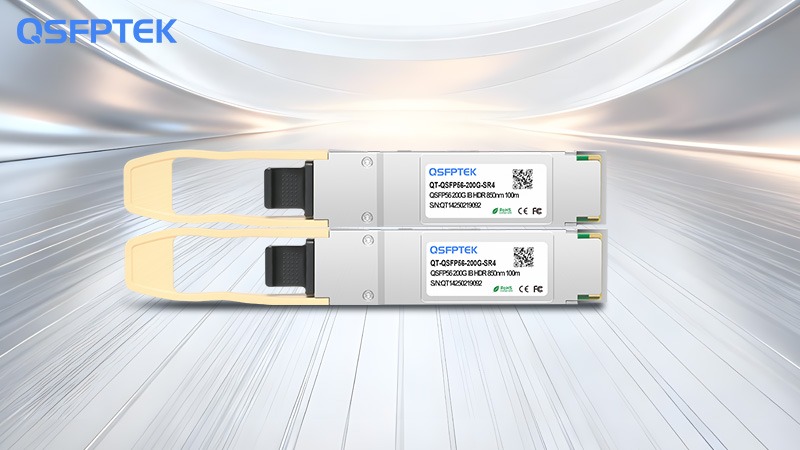
In practical deployments, 200G InfiniBand HDR modules play a critical role in translating protocol-level advancements into real-world performance. These modules provide the physical layer that enables InfiniBand HDR switches and network adapters to operate at full capacity, ensuring that compute nodes, storage systems, and accelerators can exchange data with minimal delay. QSFP56 SR4 is one of the most widely used form factors for achieving this level of performance in short-reach environments.
Understanding InfiniBand HDR Technology
The Evolution Toward 200G InfiniBand
InfiniBand has evolved through several generations, each designed to address the growing performance needs of HPC environments. From early SDR and DDR implementations to more recent EDR solutions, the technology has consistently prioritized low latency and high throughput. InfiniBand HDR builds on this legacy by doubling the bandwidth of its predecessor, EDR, while maintaining the deterministic behavior that HPC and AI workloads require.
At the core of InfiniBand HDR is a signaling rate of 50 Gbps per lane, enabled by advanced modulation techniques. By aggregating multiple high-speed lanes, HDR achieves an effective data rate of 200 Gbps, making it well suited for dense compute clusters where data movement is a critical bottleneck.
The Role of QSFP56 in InfiniBand HDR
Why QSFP56 Matters
QSFP56 is the physical form factor that enables InfiniBand HDR to be deployed at scale. Designed to support four high-speed electrical lanes, QSFP56 provides the compact size and power efficiency required for high-density switch and adapter designs. Its backward compatibility with earlier QSFP-based systems also allows for smoother transitions as networks are upgraded to higher speeds.
In InfiniBand HDR implementations, QSFP56 serves as the interface between the electrical domain of the switch or network adapter and the optical or copper media used for transmission. This makes the transceiver module a key component in ensuring signal integrity and overall network reliability.
How QSFP56 SR4 Enables 200G Connectivity
Parallel Optics and PAM4 Modulation
QSFP56 SR4 optical modules achieve 200G connectivity by combining parallel optics with PAM4 modulation. Instead of transmitting all data over a single optical channel, SR4 modules use four parallel optical lanes, each operating at 50 Gbps. These lanes are transmitted over multimode fiber using an MTP/MPO-12 connector, allowing for efficient and scalable short-reach connections.
PAM4 modulation plays a crucial role in enabling these high data rates. By encoding two bits of data per symbol, PAM4 effectively doubles the amount of information transmitted compared to traditional NRZ signaling. This approach allows InfiniBand HDR to reach 200G without requiring prohibitively high signal frequencies, making it practical for deployment in real-world environments.
850 nm Wavelength and Short-Reach Optimization
QSFP56 SR4 modules operate at an 850 nm wavelength, which is optimized for multimode fiber. This wavelength is well suited for short-distance, high-density interconnects commonly found within data centers and HPC clusters. With a typical reach of up to 100 meters over OM4 multimode fiber, QSFP56 SR4 provides sufficient distance for most intra-data-center and rack-to-rack connections.
The use of multimode fiber and short-wavelength optics also contributes to lower overall system cost compared to long-reach single-mode solutions. This makes QSFP56 SR4 an attractive choice for environments where large numbers of high-speed links are required.
Applications of InfiniBand HDR QSFP56 SR4
Enabling High-Performance Computing and AI Clusters
InfiniBand HDR QSFP56 SR4 modules are widely deployed in HPC and AI clusters where low latency and high throughput are essential. In these environments, GPUs, CPUs, and storage systems must exchange data at extremely high speeds to maintain efficient parallel processing. The 200G bandwidth provided by HDR ensures that network performance does not become a limiting factor for application scalability.
In AI training workloads, where massive datasets are distributed across hundreds or thousands of nodes, the deterministic performance of InfiniBand HDR helps reduce synchronization delays and improve overall training efficiency. QSFP56 SR4 modules enable these benefits to be realized in a compact and energy-efficient form factor.
Deployment Considerations for QSFP56 SR4
Infrastructure and Compatibility
Deploying QSFP56 SR4 modules requires careful consideration of the supporting infrastructure. Multimode fiber quality, connector cleanliness, and proper polarity management are all important factors in ensuring reliable performance. Additionally, switches and network adapters must be designed to support PAM4 signaling and the power requirements of QSFP56 modules.
Despite these considerations, QSFP56 SR4 remains relatively straightforward to deploy in environments already familiar with parallel optics. Its reliance on established multimode fiber standards and MTP/MPO connectors makes it a natural extension of existing high-speed data center cabling practices.
Conclusion
InfiniBand HDR represents a major milestone in the evolution of high-performance interconnects, delivering the bandwidth, latency, and scalability required by modern HPC and AI workloads. QSFP56 SR4 plays a central role in enabling this technology by providing a practical and efficient means of achieving 200G connectivity over short distances.
By combining parallel optics, PAM4 modulation, and a compact QSFP56 form factor, QSFP56 SR4 modules translate the promise of InfiniBand HDR into deployable solutions. For organizations building or upgrading high-performance networks, understanding how these components work together is essential to designing infrastructures that can meet today’s demands while preparing for future growth.