

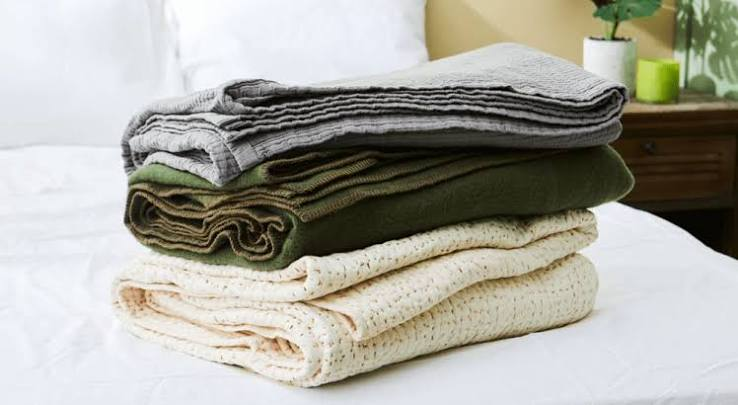
For businesses that regularly distribute branded merchandise, provide staff uniforms, or supply hospitality and healthcare environments, ordering textiles at scale is a recurring operational decision. It is not glamorous, but it carries real consequences. A delayed shipment during a product launch window, blankets that arrive with inconsistent coloring, or fabric that pills after two washes can all create downstream problems that are difficult and expensive to correct.
Custom blankets ordered in volume are one of those product categories where small decisions made early in the procurement process determine whether the order succeeds or becomes a source of friction. The considerations are not complicated, but they are easy to overlook when buyers focus primarily on price or turnaround time. This guide walks through seven things worth understanding before committing to a bulk order.
1. Understanding What “Custom” Actually Covers in a Blanket Order
The word “custom” is used broadly in textile manufacturing, and it does not mean the same thing across all suppliers. For some vendors, custom means adding a logo to a pre-made product. For others, it means specifying material composition, weave structure, dimensions, edge finishing, and coloring from the ground up. These are fundamentally different offerings, and confusing one for the other creates problems when the product arrives and does not meet expectations.
If you are a procurement manager evaluating vendors, it is worth reviewing the full scope of what a supplier’s customization service includes before issuing a purchase order. A useful starting point is reviewing what a structured Custom Blankets In Bulk overview from a qualified supplier outlines in terms of product options, print methods, and minimum order requirements. That kind of structured documentation tells you immediately whether a supplier is set up for serious business orders or primarily serving one-off consumer requests.
Businesses ordering custom blankets in bulk for distribution, hospitality, or healthcare should clarify the following before signing off on any specification sheet:
• Whether customization applies to the base material or only to the printed surface
• Whether edge and border finishing options are available and what they add to lead time
• Whether color matching is done through a standardized system or estimated by the production team
• What quality control checkpoints exist between production and shipping
2. Minimum Order Quantities Reflect Production Logic, Not Just Policy
Most textile suppliers set minimum order quantities for bulk blanket orders, and buyers sometimes interpret these minimums as arbitrary thresholds set to maximize revenue. In reality, minimums are tied to how textile production actually works. Print setup, dye batches, fabric cutting, and finishing are all processes that carry fixed costs per run. Below a certain volume, those fixed costs make unit pricing economically unsustainable for the supplier and often result in inconsistent quality across a small run.
Why Minimums Matter for Consistency
When you order custom blankets in bulk above the established minimum, production teams can calibrate equipment across the full run, maintain dye consistency throughout the batch, and allocate quality review time appropriately. Orders that fall just at or below the minimum threshold are sometimes treated as edge cases, meaning they may not receive the same level of process control as a standard production run.
If your business needs fewer units than a supplier’s standard minimum, it is worth asking directly whether the supplier accommodates smaller runs and at what cost difference. Understanding that trade-off clearly is more useful than accepting a lower minimum from a supplier who may not be equipped to deliver consistent output at that volume.
3. Print Method Determines More Than Appearance
How a design is applied to a blanket affects not only how it looks initially but how it holds up over time, how it behaves during washing, and whether it is suitable for the end-use environment. The main print methods used in bulk blanket production each have distinct characteristics that matter depending on your application.
Woven vs. Printed Designs
Woven designs are integrated into the fabric structure during manufacturing. They tend to be more durable, hold detail well at a distance, and do not involve surface treatments that can crack or fade. However, they typically carry higher production costs and longer lead times, and they are not suitable for photographic or high-resolution imagery.
Printed designs, including sublimation and direct printing, allow for more visual complexity and faster turnaround. They work well for photographic prints, gradient colors, and edge-to-edge coverage. The trade-off is that the longevity of the print is more sensitive to washing conditions, and the quality of the base fabric affects how well the print adheres and retains color.
For businesses ordering custom blankets in bulk for retail resale or brand gifting, print quality and durability should be evaluated in the context of how end users will interact with the product. A blanket given as a corporate gift is handled differently than one used daily in a healthcare facility.
4. Lead Time Is a Supply Chain Variable, Not a Fixed Promise
Bulk textile orders involve multiple production stages, each of which carries its own scheduling constraints. Fabric sourcing, print setup, production runs, quality review, and shipping all need to be sequenced correctly. When one stage is delayed, it compresses the time available for subsequent stages, which can affect quality or push the delivery date.
Building Realistic Timelines into Your Order
Buyers who anchor their entire distribution schedule to the shortest quoted lead time are taking on unnecessary risk. A more reliable approach is to request the supplier’s standard lead time range under normal production conditions, then add buffer based on your own internal deadline for receiving and distributing the product.
It is also worth clarifying what the supplier’s policy is when a production delay occurs. Do they communicate proactively? Do they offer partial shipments when possible? These are operational details that matter far more than an optimistic delivery date quoted during the sales process.
5. Artwork and File Preparation Directly Affect Output Quality
One of the most common sources of dissatisfaction in custom blanket orders comes from artwork that was not properly prepared for textile printing. A logo that looks clean on a business card or website may not reproduce well on fabric, particularly if it was saved in a low-resolution format or relies on colors that fall outside the print gamut used in textile production.
What Suppliers Need and Why
Most professional textile suppliers work with vector files for logo-based designs and high-resolution raster files for full-coverage prints. Beyond file format, colors need to be specified in a system that translates accurately to the print process being used. Many businesses submit files in standard RGB formats that look accurate on screens but shift noticeably when converted for textile output.
Requesting a digital proof or, when feasible, a physical sample before approving a full production run is a reasonable safeguard. For large orders of custom blankets in bulk, a physical sample represents a small fraction of total cost but eliminates the risk of approving a production run that does not match the intended design.
6. Material Choice Has Functional and Reputational Consequences
The material composition of a blanket determines how it performs over time, how it is perceived by the end user, and whether it is appropriate for the intended environment. This matters considerably for businesses in hospitality, healthcare, or promotional merchandise, where product quality reflects directly on the brand or organization distributing it.
Evaluating Materials Against End-Use Requirements
As the Federal Trade Commission’s textile labeling guidelines outline, fiber content disclosure is a legal requirement in the US for textile products sold or distributed commercially. This means the material your supplier uses in production has both quality implications and regulatory ones. Buyers should request full fiber content information and verify that it aligns with any labeling or compliance requirements for their industry.
For environments like hospitals or elder care facilities, fabric choices that are easy to launder, resistant to pilling, and retain their shape after repeated washing are more valuable than those that perform well only when new. For retail or gifting contexts, softness and surface appearance may carry more weight.
7. Vendor Reliability Is a Separate Question from Product Quality
A supplier can produce high-quality blankets and still be an unreliable partner for ongoing business procurement. Reliability in this context means consistent communication, accurate order documentation, dependable production timelines, and clear procedures when something goes wrong. These factors matter more over a long-term supplier relationship than they might during a single order.
Evaluating a Supplier Before Committing to Volume
Before placing a large order of custom blankets in bulk, it is reasonable to assess a supplier’s operational structure. Do they provide written order confirmations that detail specifications? Is there a named point of contact who stays with your order through production? How do they handle reprints or replacements when a quality issue is identified after delivery?
Starting with a smaller pilot order is one way to evaluate reliability before committing to higher volumes. It is also worth asking for references from other business customers in similar industries. A supplier that primarily serves consumer retail may not have the operational infrastructure to manage the expectations of a B2B or institutional buyer.
Closing: What Careful Preparation Achieves
Ordering custom blankets in bulk is not a complicated process, but it rewards careful preparation. The businesses that encounter the fewest problems are those that enter the procurement process with clear specifications, realistic timelines, properly formatted artwork, and a solid understanding of what they need from a supplier relationship.
The seven areas covered here are not exhaustive, but they represent the places where bulk blanket orders most frequently go wrong. Understanding them before you engage a supplier gives you a clearer basis for evaluating quotes, asking the right questions, and making a decision that holds up past the point of delivery. That kind of informed procurement is not about over-engineering a straightforward purchase. It is about reducing the likelihood that an avoidable problem becomes a costly one.