

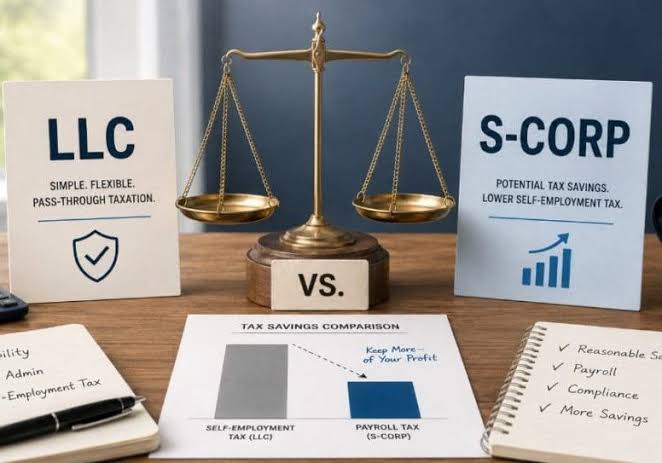
An LLC can provide a useful legal structure for a business, but forming one doesn’t automatically change how the IRS taxes its income. Many single-member LLCs are treated as sole proprietorships by default for federal tax purposes. That means an owner with an active business generally pays self-employment tax on net business earnings, in addition to any income tax owed.
That treatment isn’t necessarily a problem. An LLC can still be the right choice, and electing S corporation tax treatment isn’t automatically cheaper. The question is whether your business’s income, expenses, and administrative capacity make it worthwhile to explore another tax classification.
How a default LLC is taxed
A single-member LLC is generally treated as a “disregarded entity” for federal income tax unless it elects otherwise. The owner typically reports the business’s income and expenses on an individual return. If the LLC operates a trade or business, its net earnings are generally subject to self-employment tax, which covers Social Security and Medicare.
A multi-member LLC is generally treated as a partnership by default. Members report their share of the business’s income on their individual returns, and self-employment tax may apply to active business earnings under partnership rules.
An LLC’s legal structure and federal tax classification are separate things. The LLC can continue to exist as a legal entity while electing to be taxed as an S corporation. Under that election, a shareholder who works in the business generally must receive reasonable compensation through payroll. Wages are subject to payroll taxes; remaining business profit may pass through to the owner and generally isn’t treated as self-employment income, though it remains subject to income tax.
Understanding how an S corp works can help clarify the difference. An S corporation election doesn’t eliminate taxes or guarantee savings. It changes how compensation and business profit are handled, and it brings additional requirements.
When to talk to someone about an S corp election.
Consider asking a tax professional to compare your current setup with S corporation treatment when your business earns steady profit and you want to understand whether potential payroll-tax savings could outweigh the added costs. There’s no universal income threshold that makes an S corp right for every owner. The calculation depends on a reasonable salary for the work you perform, the profit left after wages and expenses, and the costs of payroll, bookkeeping, tax preparation, and state compliance.
A comparison should account for more than the federal tax difference. S corps generally require payroll, payroll tax filings, and a separate business tax return. Some states impose additional taxes or fees. If you already have wages from another job, that may also affect the calculation. Ask a professional to model the numbers using your actual income, role, state, and business expenses before making a decision.
If the analysis suggests a potential benefit, converting your LLC to an S corp involves more than changing a label. You’ll need to confirm eligibility, file the election correctly, establish payroll, and maintain separate business records. An S corporation owner who performs substantial services must receive reasonable compensation; distributions shouldn’t be used to replace wages for that work.
Timing is another consideration. If you meant to elect S corporation status but missed the filing deadline, don’t assume the election is effective or simply file as an S corp. Ask a qualified tax professional whether fixing a missed S corp election may be possible for your circumstances.
Your LLC may be working just as intended under its default tax treatment. Reviewing the numbers can help you see whether that remains the best fit as your business grows. Use current records, include the added compliance costs, and get professional guidance before changing your tax classification.